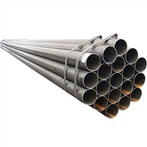
Differences Between Cold Drawing and Cold Rolling of Seamless Steel pipes:
Both cold drawing and cold rolling of seamless steel pipes are cold working processes (involving plastic deformation of steel pipes at room temperature), with the core goal of improving dimensional accuracy, surface quality, or refining the microstructure. However, there are significant differences between the two in terms of processing principles, equipment structure, product characteristics, and application scenarios. The specific differences can be compared from the following dimensions:
I. Core Differences: Processing Principles and Equipment
The fundamental difference between cold drawing and cold rolling stems from the different ways of applying external force to the steel pipe and the different structures of forming equipment, which directly determine the efficiency of the processing process and the form of the final product.
|
Comparison Dimension |
Cold Drawing |
Cold Rolling |
|
Processing Principle |
External "tensile force" is used to pull the steel pipe through a fixed conical die (the die hole diameter is smaller than the original outer diameter of the steel pipe), forcing the cross-section of the steel pipe to shrink and the length to extend, thereby achieving dimensional adjustment. |
External "compressive force" is used to pass the steel pipe through two or more sets of relatively rotating rolls (the roll gap is smaller than the original outer diameter of the steel pipe). The rolling action of the rolls uniformly reduces the wall thickness/outer diameter of the steel pipe, accompanied by slight elongation. |
|
Core Equipment |
Cold drawing machine (horizontal/vertical), dies (tungsten steel/alloy material, requiring regular replacement to ensure accuracy), traction device, annealing furnace (to eliminate work hardening after cold drawing) |
Cold rolling mill train (multi-roll type, e.g., 20-roll, 12-roll cold rolling mills), rolls (chrome-plated/alloy material, requiring precision grinding), tension control system, straightening machine |
|
Deformation Characteristics |
Large deformation per pass (reduction rate of outer diameter/wall thickness can reach 30%-50%), but uneven deformation (especially for wall thickness, prone to "eccentricity"); significant length elongation (elongation rate can reach 100%-200%). |
Small deformation per pass (reduction rate of outer diameter/wall thickness is only 5%-15%), requiring continuous multi-pass rolling; extremely high deformation uniformity (wall thickness tolerance can be controlled within ±0.05mm); slight length elongation (elongation rate of 10%-30%). |
II. Comparison of Product Characteristics: Accuracy, Surface, and Performance
The differences in processing principles directly lead to distinct disparities between cold-drawn pipes and cold-rolled pipes in terms of dimensional accuracy, surface quality, and mechanical properties, which define the boundary of their application scenarios.
|
Product Characteristic |
Cold-Drawn Seamless Steel Pipes |
Cold-Rolled Seamless Steel Pipes |
|
Dimensional Accuracy |
Moderate accuracy: |
High accuracy: |
|
Surface Quality |
Average: |
Excellent: |
|
Mechanical Properties |
More significant work hardening: |
Mild work hardening: |
|
Microstructure Uniformity |
Poor: |
Excellent: |
III. Application Scenarios: Matching Processes to Requirements
The choice between cold drawing and cold rolling essentially lies in balancing cost, accuracy, and performance-cold drawing is suitable for low-cost, moderate-accuracy requirements, while cold rolling is suitable for high-accuracy, high-surface-quality requirements.
|
Process |
Typical Application Scenarios |
Examples of Representative Products |
|
Cold Drawing |
1. General fluid transportation (low accuracy requirements, e.g., tap water, natural gas); |
Grade 20 cold-drawn fluid pipes, Q235 cold-drawn structural pipes, Grade 10 cold-drawn mechanical pipes |
|
Cold Rolling |
1. High-precision fluid transportation (e.g., hydraulic systems, lubrication systems, requiring strict control of wall thickness tolerance to prevent leakage); |
Grade 20 cold-rolled hydraulic pipes, 1Cr18Ni9Ti cold-rolled food-grade pipes, cold-rolled pipes for precision bearings |
Key Summary: Three Core Differences
1. Different sources of force: Cold drawing relies on "tensile force" to pull the pipe through a die, while cold rolling uses "compressive force" to roll the pipe through rolls;
2. Different accuracy and surface quality: Cold rolling is far superior to cold drawing in terms of accuracy (especially wall thickness uniformity) and surface quality;
3. Different cost and efficiency: Cold drawing has high single-pass efficiency and low cost, while cold rolling has low multi-pass efficiency and high cost.