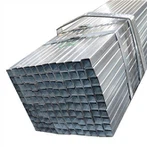
Choosing between Electric Resistance Welded (ERW) pipes and seamless pipes depends on several factors, including the intended application, material properties, cost, and manufacturing process. Here's a guide to help you decide:
1. Manufacturing Process:
ERW Pipes:
Process: Made by rolling metal and welding it longitudinally.
Material: Typically made from cold-rolled or hot-rolled steel coils.
Seam: Visible seam along the length where the edges are welded together.

Seamless Pipes:
Process: Made by piercing a solid billet, then stretching and rolling it to the desired size.
Material: Generally made from solid steel billets.
Seam: No seam, resulting in uniform strength across the pipe.
2. Mechanical Properties:
ERW Pipes:
Strength: Adequate for many standard applications.
Uniformity: Seam could be a point of weakness, but modern welding techniques have improved their reliability.
Pressure Handling: Suitable for medium pressure applications.
Seamless Pipes:
Strength: Higher mechanical strength due to the absence of a seam.
Uniformity: No seam, so the pipe has uniform strength and is less likely to fail under pressure.
Pressure Handling: Better for high-pressure applications.
3. Cost:
ERW Pipes:
Cost: Generally cheaper due to simpler and faster manufacturing processes.
Economic Feasibility: More economical for standard applications.
Seamless Pipes:
Cost: Typically more expensive due to the more complex manufacturing process.
Investment: Higher cost is justified in critical applications where reliability and strength are crucial.
4. Application:
ERW Pipes:
Common Uses: Water and gas pipelines, fencing, scaffolding, and low-pressure applications.
Limitations: Not ideal for very high-pressure or critical applications.
Seamless Pipes:
Common Uses: Oil and gas industries, high-pressure boilers, petrochemical industries, and other critical applications.
Limitations: Overkill for applications where lower strength and pressure handling are sufficient.

5. Size and Availability:
ERW Pipes:
Size Range: Available in a wide range of diameters and thicknesses, especially in larger diameters.
Availability: Widely available and easy to source.
Seamless Pipes:
Size Range: Often available in smaller sizes, but large sizes are more difficult to produce.
Availability: May be less available, especially in very large sizes.
6. Corrosion Resistance:
ERW Pipes:
Corrosion Resistance: Similar to seamless pipes if both are made from the same material, but the seam could be a weak point.
Seamless Pipes:
Corrosion Resistance: Uniformity across the pipe might give it a slight advantage in environments where corrosion is a concern.
Conclusion:
Choose ERW Pipes if:
You need a cost-effective solution.
The application involves low to medium pressure.
Large diameter pipes are required.
Choose Seamless Pipes if:
The application requires high pressure or critical performance.
Higher strength and reliability are necessary.
The application is in industries like oil and gas, power plants, or chemical processing where failure is not an option.
These considerations should help you select the appropriate type of pipe for your specific needs.